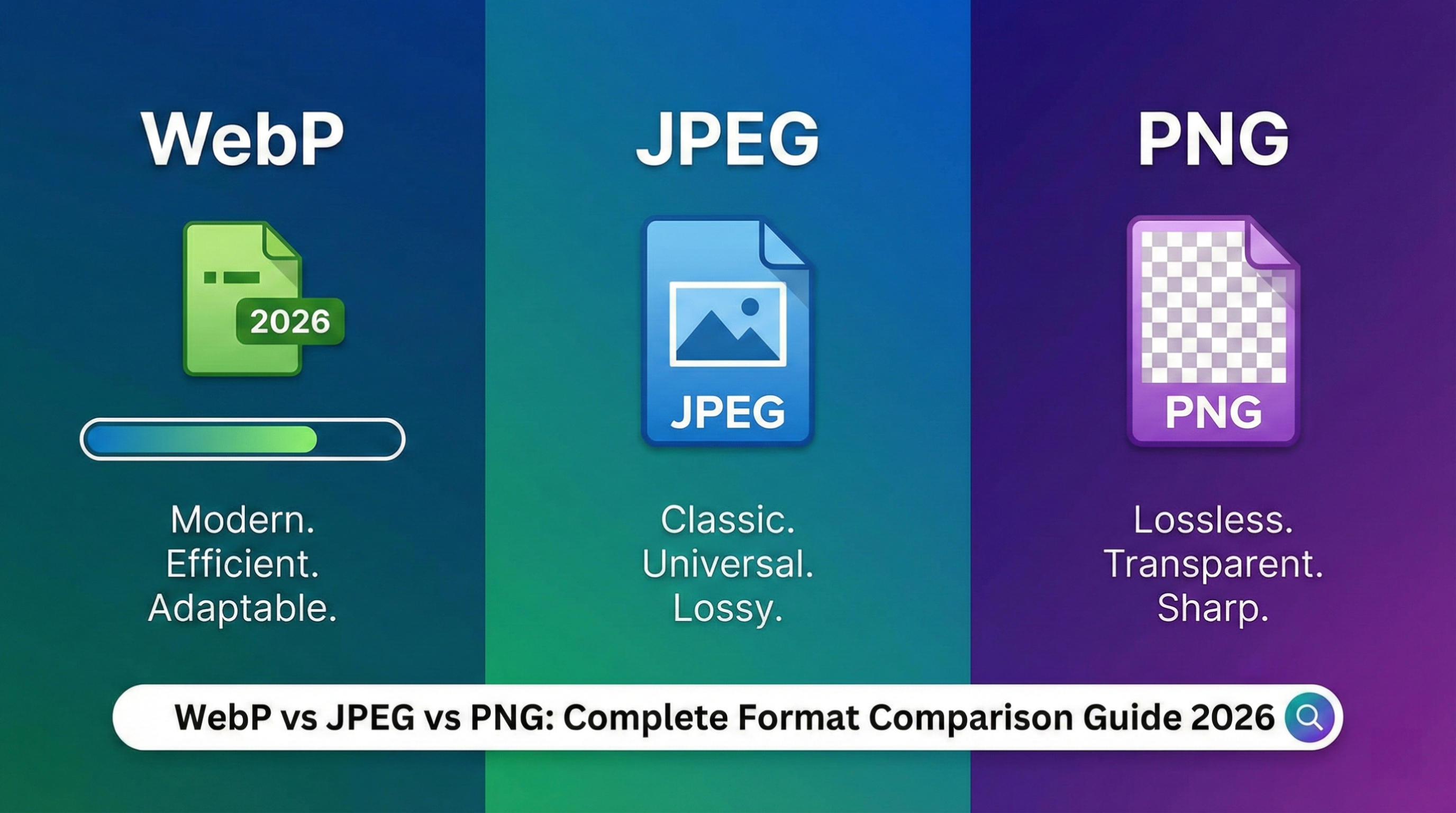
Choosing the right image format is pivotal for website performance and stoner happiness. There are three formats that dominate the internet by 2026: WebP, JPEG, and PNG. Each format offers unique advantages and is ideal for certain situations.
Understanding Ultramodern Image Formats
In moment's digital geography, image format selection directly impacts your website's success. The wrong choice can lead to slow cargo times, poor SEO rankings, and frustrated callers. Let's explore each format's strengths to help you make informed opinions.
The Modern Standard: WebP
Google developed WebP, which offers greater contraction than traditional formats. WebP images are frequently 25-35% lower than JPEGs while maintaining analogous quality — a game-changer for modern websites.
Since its preface, WebP has come the go-to format for performance-conscious inventors. It combines the stylish attributes of both JPEG and PNG into a single, protean format.
WebP's Main Advantages
Then's why WebP has become the assiduity standard:
- Advanced Compression: Dropped train sizes without lowering quality
- Translucency Point: Enhanced contraction, analogous to the nascence channel of PNG
- Capability to Animate: Can replace animated GIFs with advanced quality ones
- Comprehensive Browser Compatibility: By 2026, it will be supported by all well-known cybersurfers
When to Use WebP
WebP is ideal for moment's performance-acquainted websites. Use it for:
- Blog prints and editorial content
- Product photography for e-commerce
- Prominent illustrations and hero images
- Any graphic content where train size is important
- Mobile-first websites and operations
JPEG: The Universal Standard
Despite being introduced in 1992, JPEG remains the most extensively habituated picture format across all platforms. The maturity of bias and operations still support it as their primary image format.
JPEG excels at compressing images with a different diapason of colors — especially prints and complex illustrations. Its lossy contraction algorithm achieves remarkable train size reductions while maintaining respectable visual quality.
Benefits of JPEG
- Wide Comity: Works with all systems, indeed aged bones
- Excellent for Taking Filmland: Effectively compresses complex images
- Balance Image Quality: Train size as necessary for optimum rigidity
- Small Train Sizes: Effective image contraction
When to Use JPEG
Choose JPEG when you need:
- Maximum comity: Works on every device and platform
- Filmland and prints: Ideal for complex images with slants
- Dispatch attachments: Universal format everyone can open
- Extensive distribution: Ensuring all donors can view your images
- Heritage system support: Works with aged software and bias
PNG: The Quality Leader
When absolute quality is non-negotiable, PNG is your format of choice. Anyhow of how numerous times the train is changed and saved, the quality remains innocent thanks to PNG's lossless contraction.
This makes PNG the preferred format for professional design work, ensigns, and any content that requires perfect clarity and sharpness.
Advantages of PNG
- Complete Preservation of Quality: Through lossless contraction
- Translucency Point: Complete nascence channel with 256 situations
- Sharp Images: Ideal for ensigns, icons, and textbook
- No Artifacts: Crisp edges and fine details
When to Use PNG
For ensigns, icons, textbook plates, images taking translucency, and any material that must maintain its quality, choose PNG.
Comparison of Train Sizes
To illustrate the practical differences, then's a real-world comparison using a typical picture with 1920×1080 pixels:
- PNG (lossless): 2.5 to 4 MB — Perfect quality, largest size
- JPEG (90% quality): 800-1200 KB — Excellent quality, 70% lower
- WebP (90% quality): 500-800 KB — Excellent quality, 80% lower
These differences multiply across entire websites with hundreds or thousands of images.
Effect on Performance
Image optimization is n't just about saving storehouse space — it directly impacts your website's success metrics. Reducing the size of picture lines incontinently improves:
- The speed at which a runner loads
- Bandwidth operation
- The Core Web Vitals pointers
- SEO effectiveness
- The stoner experience on mobile bias
Stylish Practice Recommendations
Apply these professional strategies for optimal results:
- Progressive Enhancement: Use WebP as your main format while keeping JPEG as a backup for aged cybersurfers
- Format Selection: When WebP is not available, use JPEG for complex images and prints
- Translucency Handling: Choose PNG for ensigns, icons, and other images that must be transparent
- Pre-Optimization: Before posting any images to your website, make sure they're optimized
- Responsive Images: Use flexible filmland that come in a variety of sizes for different bias
- Testing: Always test images across different bias and cybersurfers
Tips for Converting
While changing formats, follow these professional guidelines:
- For the stylish quality and size reduction, convert from PNG to WebP
- Keep the original PNG lines as master lines
- For the stylish results, try out WebP quality settings between 80 and 90
- As a backup for comity with aged systems, use JPEG
In Summary
WebP will be the most popular option for utmost online material in 2026, striking a good balance between train size and quality. Its superior contraction and wide cybersurfer support make it the smart dereliction choice.
Still, having familiarity with all three formats allows you to choose the stylish one for your particular conditions:
- WebP: For contemporary websites that value speed and performance
- JPEG: For optimal comity across all platforms and bias
- PNG: For filmland that demand exceptional quality and translucency
The key is understanding when each format excels and applying that knowledge strategically across your systems.